Comparison of two work models for teams that value quiet, fast internet, and flexibility
Do you run an IT company or a startup and are looking for a place to work? You have two main options on the market: coworking or a serviced office. Both sound similar, both offer a desk, internet, and coffee. But in daily work, they are completely different experiences.
For tech teams, this difference is particularly significant. A programmer who needs four hours of uninterrupted focus will evaluate a space differently than a marketer who spends half the day on calls. A startup that grows month by month has different needs than a solo freelancer.
This article will help you choose a model that truly fits your team — not to the general vision of a "modern office," but to how you actually work.
.jpg)
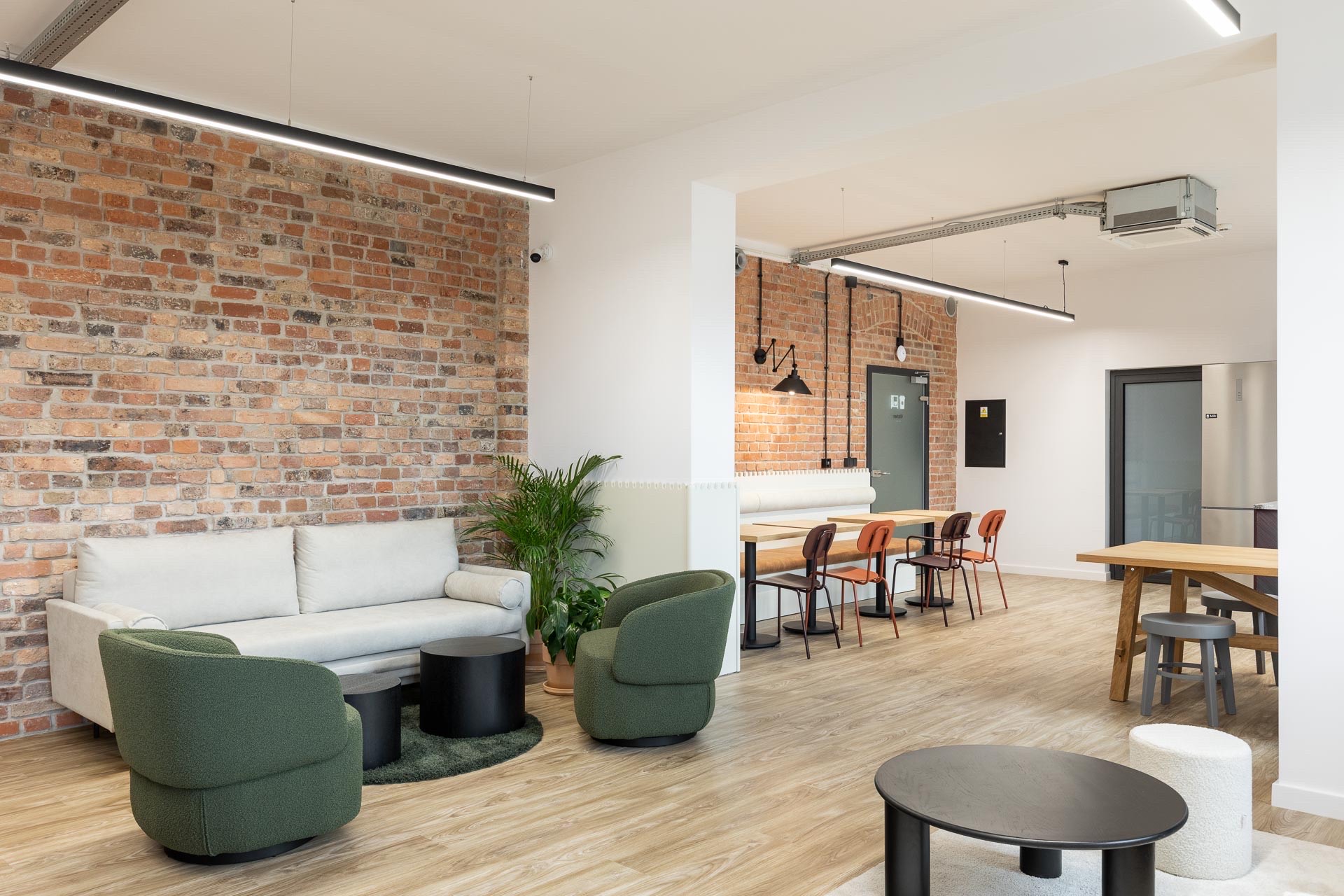
Coworking is a desk in a shared space with other people. You work in an open room next to people from various companies and industries. You can have a hot desk — meaning you sit wherever there's a free spot — or a dedicated desk, which is assigned to you but is still in an open space.
A serviced office is a private office with a lockable door — but with the same services as coworking. Furniture, internet, cleaning, reception, coffee — all included. You get your own space, but you don't have to organize anything.
.jpg)
This is probably the most important factor for tech teams. Studies show that after an interruption to deep work, a programmer needs 15-25 minutes to regain full concentration. In an open coworking space, there can be a dozen such interruptions daily.
A serviced office eliminates this problem. You close the door — and you have guaranteed quiet for as many hours as you need.
At Cluster Zabłocie, we also have an intermediate solution — a quiet zone in the coworking space, where library-like rules apply. For individuals who work solo and don't need a private office but require quiet — this is a good compromise.
For an IT company, internet speed and stability are not a "bonus" — they are a prerequisite. Video conferences, deployments, working on remote servers, transferring large files — everything requires a connection that doesn't fail.
At Cluster, all locations have fiber optic internet. In serviced offices, you can also have a dedicated network — separate from the rest of the building, which enhances both performance and security.
If your company works with client data, source code, or information covered by an NDA — the work environment matters. In an open coworking space, you have no control over who sees your screen, who hears your conversations, and who uses the same network.
A serviced office gives you lockable doors, access control, and the option to configure a dedicated network. For IT companies working with international clients — especially from the USA, UK, or Scandinavia — this is often a compliance requirement, not a preference.
A startup with 3 people today might have 8 in six months. Or the opposite — a pivot, cuts, a change in model.
In coworking, scalability is simple: you just buy more desks. But the moment your team exceeds 3-4 people — an open space starts to become disruptive. You talk to each other, hold stand-ups, plan sprints — and disturb others.
A serviced office scales differently: you take a larger office in the same building. No relocation needed. At Cluster, we see this regularly — teams start with an office for 3 people, and after a year, they occupy a space for 10-15.

Coworking is a good choice if:
At Cluster, you can start with a pass — 10 entries per month, at any location. This is enough to check if coworking is for you.
A serviced office will be a better fit if:
You don't have to choose one or the other. Many IT teams at Cluster combine both models:
At Cluster, you can have all of this within one location. An office in Zabłocie, hot desks in the same building, meeting rooms on-site. One billing, one point of contact.
.jpg)
Krakow (Zabłocie, Stare Podgórze, Plac Inwalidów): Hot desk — 75 PLN net per day, 650 PLN net per month. Dedicated desk — 875 PLN net per month (750 PLN with a 6-month contract). 10-entry pass — 399 PLN net per month or 549 PLN net per quarter.
Warsaw (Sienna Center): Hot desk — 85 PLN net per day, 850 PLN net per month. Dedicated desk — 1,850 PLN net per month (1,350 PLN with a 6-month contract). 10-entry pass — 550 PLN net per month or 850 PLN net per quarter.
Katowice (Stary Dworzec): Hot desk — 75 PLN net per day, 549 PLN net per month. Dedicated desk — 749 PLN net per month (599 PLN with a 6-month contract). 10-entry pass — 399 PLN net per month or 549 PLN net per quarter.
Passes work in all locations — one pass, any city.
The price depends on the office size and contract length. Offices are available from 2-person spaces to those for 20+ people. Contact us — we'll prepare an offer tailored to your team.
.jpg)
75% of serviced office tenants at Cluster are IT companies. This is no coincidence. Here are a few things that matter to them:
Coworking and serviced offices are two good solutions — but for different stages and different needs. For an IT company or startup, the key questions are: how many people, how much quiet, how much privacy, and how much flexibility do you need?
If you're starting solo or with one other person — coworking will suffice. If your team is growing, and you need quiet for coding and privacy for meetings — a serviced office will give you what an open space cannot.
And remember – you don't have to commit forever. At Cluster, you can start with a hot desk, move to a dedicated desk, and then to a private office. No relocation, no change of address. Your office grows with you.
Want to see which option suits your team? Come for a trial day at any Cluster location – you'll see the coworking spaces and private offices firsthand and decide on the spot.
Cluster Offices
Kraków — Zabłocie, Stare Podgórze, Plac Inwalidów
Warsaw — Sienna Center
Katowice — Stary Dworzec
www.clusteroffices.com | +48 726 550 404 | hi@clusteroffices.com
